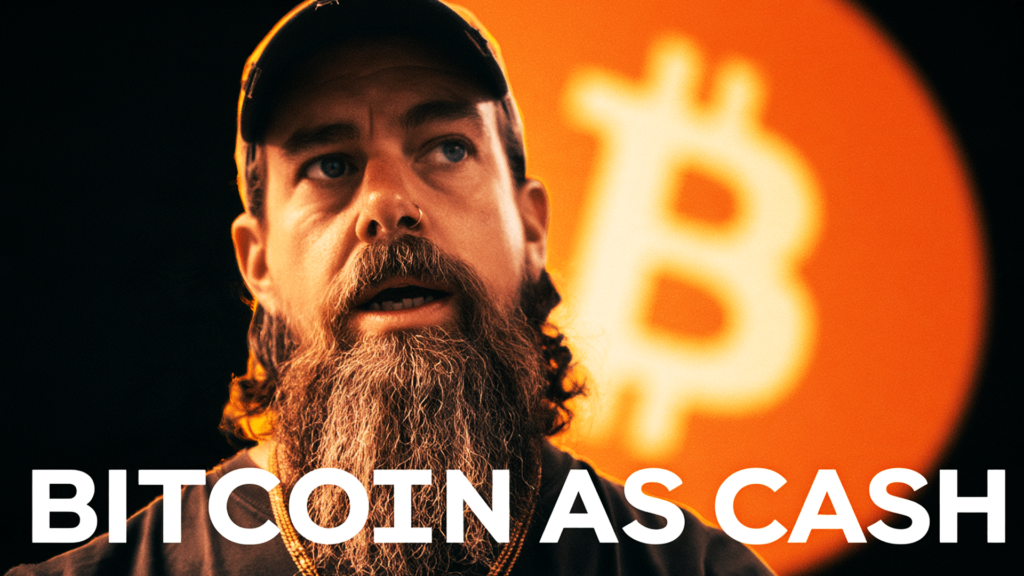
Jack Dorsey has long argued that Bitcoin succeeds only if people can use it as everyday money. In a recent discussion he returns to that standard and measures current progress against the original white paper. The title of the document is “Bitcoin: A Peer-to-Peer Electronic Cash System.” Dorsey states that if Bitcoin remains only a store of value that people hold and watch, the project has not met its stated goal. Success, in his view, requires that ordinary people can send and receive value without asking permission from a bank or payment processor.
Nation-state reserves receive a qualified assessment. Dorsey says such purchases are positive for the country that acquires Bitcoin and for existing holders at the moment of purchase. He does not treat them as sufficient. If the asset ends up functioning solely as digital gold, he considers the outcome a failure. The distinction is practical rather than philosophical. A reserve asset can sit in a vault. Electronic cash must move between people on a regular basis. The white paper describes a system for peer-to-peer payments. That description has not yet been realized at scale.
The obstacles Dorsey identifies are straightforward. Most people still do not hold Bitcoin. Those who do often acquired it as an investment and have few places to spend it. Merchants are not widely accepting it. User interfaces remain difficult for non-technical participants. These conditions reinforce one another. Without places to spend Bitcoin, people have little reason to acquire it for any purpose other than price appreciation. Without widespread ownership, merchants have little incentive to accept it. The result is a network that functions more as a speculative asset than as a payment system.
Layer-two protocols such as Lightning and other payment-focused networks already exist on top of Bitcoin. Dorsey acknowledges the technical progress but maintains that accessibility remains the larger constraint. Additional development is always possible, yet the primary barrier is not the absence of another protocol. It is the absence of routine use. People need both a reason to hold Bitcoin and a clear path to spend it. Until those conditions improve, the chicken-and-egg problem continues.
Cash App, which Dorsey helped build, was designed in part to lower the first barrier. The application includes a Bitcoin exchange that makes acquisition relatively simple for retail users. That step addresses the “people do not have Bitcoin” problem. The harder step, he says, is the next one: giving those holders somewhere to use the Bitcoin they already own. Merchants must see a benefit in accepting it, and individuals must see a benefit in spending it. Without that second stage, the investment vehicle remains the dominant use case.
Dorsey frames the desired outcome in terms of permission. He wants people anywhere in the world to move money without asking a bank whether a deposit or withdrawal is allowed. That standard applies equally to individuals and to merchants. A merchant that can receive Bitcoin directly, settle it, and optionally convert it, reduces dependence on traditional payment rails that can freeze accounts or impose high fees. An individual who can pay with Bitcoin without first converting to local currency gains a similar independence. Both sides of the transaction must find the process easier or more advantageous than the alternatives.
The discussion also touches on incentives. The video’s channel host adds a practical suggestion at the end: merchants can offer meaningful discounts when customers pay in Bitcoin. A steep discount creates an immediate reason for holders to spend rather than hold. It also gives the merchant a competitive advantage with customers who already own Bitcoin. Over time, repeated discounts can increase the volume of Bitcoin circulating as payments and reduce the share that remains idle in wallets. The approach does not require new protocol changes. It requires merchants to treat Bitcoin acceptance as a customer-acquisition tool rather than as a niche experiment.
Accessibility compounds across several layers. First, people must be able to acquire Bitcoin without excessive friction or cost. Second, once they hold it, they must be able to spend it at businesses they already use. Third, the experience of spending must be simple enough that non-technical users do not abandon the attempt. Fourth, merchants must receive value that justifies the operational changes required to accept it. Progress on any one layer helps the others, but stagnation on any single layer slows the entire system. Dorsey notes that many of these problems are already being addressed by different teams, yet the decisive factor remains whether people ultimately value Bitcoin enough to use it for exchange rather than only for storage.
The investment use case is not dismissed. Dorsey calls it a useful first step because it brings new participants into the network. The limitation appears when that step becomes the final one. If holders never spend, and if merchants never accept, the network does not develop the liquidity and habit formation required for electronic cash. Daily use creates additional demand for the asset, improves the tools that support payments, and gives developers clearer feedback on what still needs to be built. Store-of-value demand alone does not generate the same cycle.
Regulatory and technical risks remain. Payment networks can still face compliance requirements, and user error can still result in lost funds. Those risks exist for any monetary system. The specific risk Dorsey highlights is different: the risk that Bitcoin never moves beyond the investment category. In that scenario, the original purpose described in the white paper is not achieved, and the project, by his standard, has not succeeded. The remedy he proposes is continued focus on usability and merchant adoption rather than further emphasis on price alone.
For merchants evaluating Bitcoin acceptance, the practical questions are concrete. What discount or incentive will attract holders who currently have few places to spend? How quickly can received Bitcoin be converted or used to pay suppliers? What tools reduce the operational burden of handling a volatile asset? Answers to these questions determine whether acceptance remains experimental or becomes routine. For individuals, the corresponding questions are equally direct. Where can Bitcoin be spent today without converting to local currency first? How much easier is that process than existing payment methods? Repeated positive answers on both sides are what move the system from digital gold toward electronic cash.
Dorsey’s position returns consistently to the same test. Bitcoin was proposed as a peer-to-peer electronic cash system. If people cannot use it for that purpose on a regular basis, the description has not been realized. Nation-state purchases and investment demand can raise the price and expand awareness. They do not, by themselves, create the habit of spending. That habit requires accessible acquisition, widespread merchant acceptance, and a clear advantage for both parties in the transaction. Progress on those fronts determines whether Bitcoin remains primarily a store of value or becomes the payment system originally described.
The tools for payments continue to improve. Lightning and related protocols already reduce the cost and time of small transactions. Cash App and similar applications have lowered the barrier to first ownership. The remaining work, as Dorsey describes it, is to connect those holdings to actual spending opportunities and to give merchants reasons to accept the asset. Merchant discounts are one direct method. Better interfaces and clearer settlement options are others. Each improvement that makes spending easier increases the chance that holders will use Bitcoin rather than only hold it. That shift, repeated across many users and businesses, is what converts a digital reserve asset into functioning electronic cash.