Adam Curry described stablecoins as digital dollars that remain pegged to the U.S. dollar and are already used for payments across the internet and in applications worldwide. The peg holds because the issuing company holds matching reserves of U.S. debt. The company buys Treasury bonds or T-bills that pay interest. For each dollar of Treasuries purchased, the issuer can create one stablecoin. Those tokens then circulate as a dollar-denominated instrument that users can send without opening a traditional bank account in the receiving jurisdiction.
Tether provides the clearest current example. Curry stated that the company holds roughly $160 billion in U.S. debt, an amount larger than the holdings of most countries. For each of those dollars the firm has issued a corresponding stablecoin. With a staff of about fifty people, the operation collects the interest paid by the Treasuries, described as approximately 4 percent annually. The business model is therefore the spread between the yield earned on the collateral and the zero yield paid to stablecoin holders, plus any fees collected on issuance or redemption. The scale of the collateral position means that continued growth in stablecoin supply directly increases demand for U.S. government debt.
Curry argued that this structure creates a two-for-one outcome for the United States. Each new dollar of Treasury debt purchased by a stablecoin issuer simultaneously creates a new digital dollar that can be used globally as a reserve currency. Flooding the world with these instruments expands the international reach of the dollar without requiring the Federal Reserve to issue the tokens itself. He suggested that the arrangement could support a future monetary framework in which the dollar remains the primary reserve currency while its domestic valuation is adjusted through some form of accord or policy package. The goal, in his framing, would be to keep the United States competitive as an export economy even though much of its physical production has moved overseas.
Bitcoin enters the discussion as a separate asset. Curry noted that Bitcoiners prefer a single currency used by everyone, yet he characterized Bitcoin today as closer to digital gold. It is easier to move than physical gold and retains value, but it does not currently function as everyday money in the way the original white paper described. He still assigned it a role in a U.S. strategic reserve. Stablecoins, particularly those issued by Tether, appeared to him as the more immediate vehicle for expanding dollar payments. At the same time he acknowledged that stablecoins can be frozen or restricted by the issuer, a feature that concerns users who want an uncensorable alternative. Bitcoin, he said, remains useful as a backup that cannot be stopped by the same administrative controls.
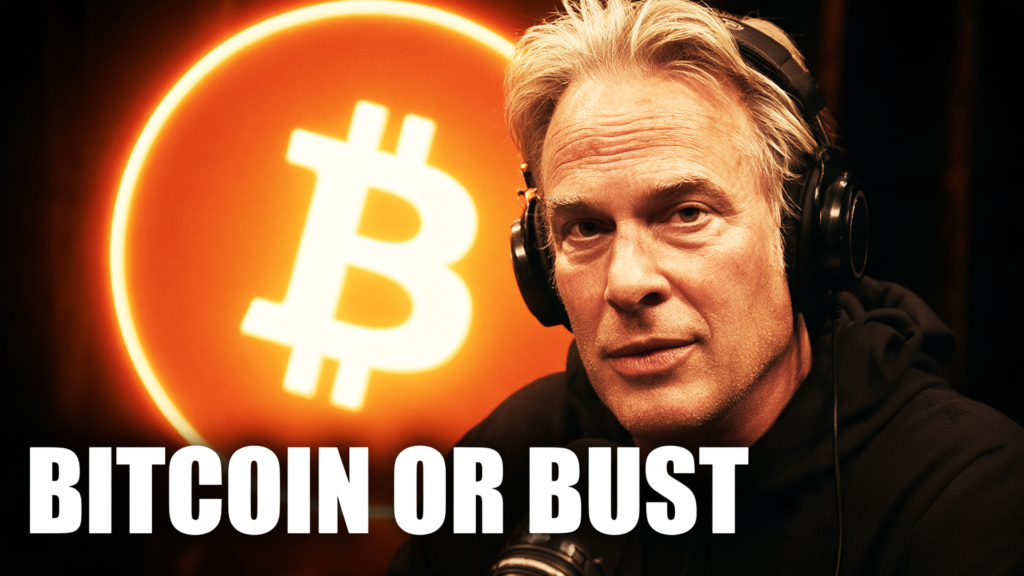
The channel that republished the clip rejected the separation of roles. Its description states that Bitcoin is currency and that users do not have to accept stablecoins. Stablecoins decline in purchasing power over time with the dollar, and the issuer retains the ability to freeze balances. The alternative presented is “bitcoin or bust.” Under that view, any system that relies on a private company to hold Treasuries and issue matching tokens reintroduces the same permissioned structure that Bitcoin was designed to avoid. The fixed supply and the inability of any single party to alter the issuance schedule remain the distinguishing features.
The practical difference appears in settlement and control. A stablecoin transaction can be reversed or blocked if the issuer or a regulator directs it. A Bitcoin transaction, once confirmed with sufficient depth, cannot be reversed by the issuer because there is no issuer. Custody of the private keys determines control. The trade-off is volatility and the current limited number of merchants that accept Bitcoin directly. Stablecoins reduce short-term price risk for users who need to hold a dollar balance, yet they preserve the ability of the issuer to intervene. Bitcoin removes that intervention at the cost of price fluctuation against the dollar.
Curry’s description of Tether’s balance sheet highlights a second distinction. The interest earned on the Treasury collateral accrues to the issuer. Bitcoin holders receive no yield from the protocol itself. Any return comes from price appreciation or from separate activities such as lending that reintroduce counterparty risk. The stablecoin model therefore concentrates yield with the issuer while distributing a dollar-denominated token. The Bitcoin model distributes the asset itself and leaves yield generation, if any, outside the base protocol.
For users deciding between the two, the relevant questions are custody, censorship resistance, and time horizon. A stablecoin balance can be moved quickly across borders and spent in applications that already accept it, provided the issuer has not frozen the address. The balance remains exposed to the credit and policy decisions of the issuer and to the inflation rate of the underlying dollar. A Bitcoin balance can be moved only by the holder of the keys and cannot be frozen by a company. Its purchasing power fluctuates with market demand for a fixed supply. Over longer periods the fixed supply has produced appreciation against most fiat currencies, but short-term declines have also occurred.
The policy implication Curry raised is that expanded stablecoin issuance increases structural demand for U.S. Treasuries. If that demand continues to grow, it supports the financing of U.S. deficits while extending dollar usage. Bitcoin does not create the same direct demand for Treasuries. Its adoption instead reduces the share of global savings that remains inside the dollar system. The two assets therefore pull in different directions: one extends the existing monetary framework through private issuance backed by government debt, and the other offers an exit from that framework through a non-sovereign asset with a hard cap.
The channel’s position treats the exit as the preferable outcome. Because stablecoins remain redeemable into the same dollar whose purchasing power declines, and because the issuer can restrict their use, they do not solve the problems that motivated Bitcoin’s design. Bitcoin’s limitations in daily commerce are acknowledged, yet the argument is that those limitations are preferable to reintroducing an intermediary that can freeze funds. Improvements in layer-two payment systems can narrow the usability gap without restoring issuer control.
Both views can be examined against observable mechanics. Stablecoins require continuous matching of collateral and circulating tokens, and they grant the issuer administrative power over balances. Bitcoin requires no collateral beyond the energy and hardware that secure the network, and it grants administrative power only to the holder of the private keys. Tether’s reported Treasury holdings demonstrate that a private company can intermediate large volumes of dollar demand. Bitcoin’s fixed supply demonstrates that no company or government can expand the total number of units. Users who prioritize seamless dollar payments and accept issuer risk can use stablecoins. Users who prioritize the removal of that risk and accept price volatility can use Bitcoin. The choice determines whether the next dollar of savings remains inside a system that can be expanded and restricted or moves into a system whose rules cannot be changed by any single participant.