In a conversation that cuts straight to the value of Bitcoin itself, Robin Seyr and Mike Carson explore what the network’s block space can do beyond transferring value. Carson, drawing on years in the traditional domain industry, points out that the thing people overlook is the ledger. Bitcoin’s block space is a decentralized, highly secure record that anyone can verify. That same property makes it the right place to anchor names. The video, titled Bitcoin Naming System, walks through why current internet naming fails and how Spaces Protocol turns Bitcoin’s existing security into human-readable, censorship-resistant identities without a new chain, a new token, or a foundation.
Traditional domain names look convenient until they are not. Carson notes the familiar problems from his earlier work: renewal fees that never end, registrars that can refuse service, and higher authorities that can intervene. He cites the .cat top-level domain, which Spanish authorities ordered taken down during a political dispute. He also references security incidents such as the Squarespace compromise that affected crypto-related sites. In each case the name itself was never fully owned by the person who paid for it. The system depends on a chain of trusted parties, from ICANN down through registrars and certificate authorities. When any link fails or decides against the user, the name can be altered, seized, or simply allowed to expire. Carson and Seyr frame this as the opposite of the cypherpunk ideal that Bitcoin already demonstrated for money.
Spaces Protocol addresses the same class of problem by treating names as Bitcoin UTXOs. A top-level Space, written in the form @bitcoin or any other label, is acquired through a permissionless auction that runs on Bitcoin’s existing scripting. Winning bids are burned, so no entity extracts a profit from the initial distribution. The protocol limits rollout to roughly ten Spaces per day, or about 3,600 community identifiers per year. This cap prevents the land-grab dynamics that plagued early domain markets while still leaving room for real demand to set prices. Once registered, the Space is a Bitcoin output controlled by the holder’s key. It can serve as a community identifier in the same way .com or .org functions on the traditional web, except the root of trust is Bitcoin’s proof of work rather than a corporation or multi-stakeholder body.
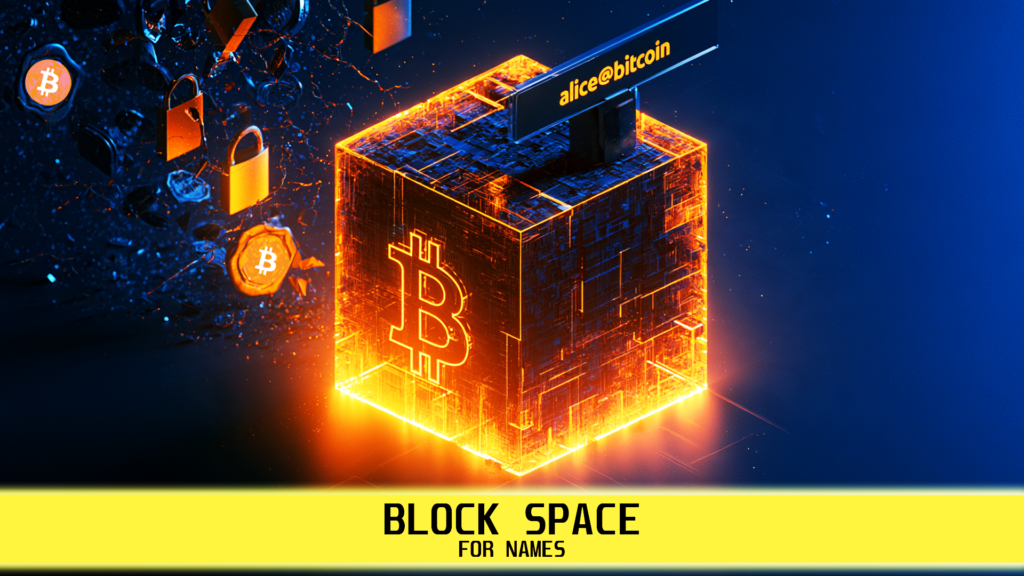
Under each Space, users create subspaces, also called handles. These are the individual identities people actually share: alice@bitcoin, bob@nostr, or mike@x. The video explains that subspaces operate primarily off-chain. The operator of the Space maintains a Merkle tree of issued handles and periodically commits a compact 32-byte root on-chain. Ownership of a handle is proven with certificates that include zero-knowledge proofs of inclusion and of non-existence in prior roots. This design lets millions of names exist under a single Space with almost no additional block-space cost. The holder of the handle receives a certificate that remains valid even if the operator later disappears. The subspace can also be bound to an on-chain UTXO when interactive features are needed, so users who want full on-chain control are not forced to trust the off-chain layer forever.
Carson emphasizes that the protocol introduces no separate token and no new blockchain. Everything rests on Bitcoin. There is no foundation that can change the rules after launch. The verification path is designed so that a light client, using zero-knowledge techniques, can check the state without downloading the full history. A phone or a simple wallet can therefore confirm that a given handle belongs to a particular key and that the commitment is anchored in Bitcoin. This matches the property Carson and Seyr keep returning to: the ledger is the valuable thing, and Spaces simply uses a tiny fraction of its security for names.
The practical uses follow directly. On Nostr, a long npub becomes a short handle that still verifies against Bitcoin. Wallet software can resolve a name to a payment address under BIP 353 style schemes, so users send to a readable label instead of a 62-character string. Websites can be resolved through the same certificates without relying on third-party certificate authorities for the naming step itself. Peer-to-peer applications gain identities that cannot be censored by a platform. In each case the user holds the key that controls the name. No registrar can refuse a renewal. No government order directed at a single company can erase the binding that Bitcoin has already confirmed.
The auction mechanism itself is worth noting. Because names enter through open bidding and the proceeds are burned, early participants cannot simply claim every valuable word at negligible cost. The daily limit forces prioritization. High-demand names surface through competition rather than through insider allocation or first-come registration. Carson’s background in domains makes the contrast clear: the old system rewarded speed and capital in ways that concentrated ownership before ordinary users arrived. Spaces keeps the initial distribution open and tied to Bitcoin’s own scarcity.
For developers the surface is straightforward. Resolution libraries already exist in multiple languages. An application can query a handle, receive the associated records, and verify the proof locally against the Bitcoin-anchored root. The protocol does not require the application to trust an external naming server once the certificate is checked. Operators who want to issue handles under their own Space run the commitment process; the resulting certificates are portable. Users who prefer not to operate anything can obtain a handle under an existing Space such as @bitcoin through available apps and then control the key themselves.
The video returns several times to the idea of the sovereign individual. Bitcoin removed the need to trust a central bank for the supply of money. Spaces removes the need to trust a registrar or platform for the names people use to find each other, pay each other, and prove identity. The technical pieces (UTXO representation, burned auctions, Merkle commitments, zero-knowledge certificates) exist to make that property hold at scale. Because the design reuses Bitcoin’s security and scripting, it does not ask users to evaluate a new consensus system or a new token’s economics. The security assumptions stay the ones they already accept for bitcoin itself.
Adoption, as the discussion implies, is the remaining work. The protocol is specified, the auctions have run, and handles can be issued. What expands from here are the wallets that display a name instead of a raw address, the Nostr clients that treat a Spaces handle as a first-class identity, the browsers or proxies that resolve a site from a certificate, and the communities that decide a given Space is the right namespace for their members. Each of those steps is possible today because the naming layer is already anchored where the money layer is anchored.
The conversation between Seyr and Carson is useful precisely because it starts from Bitcoin’s block space rather than from a feature list. Once the ledger is accepted as the secure place to record value, the same ledger can record the binding between a readable name and a key. Spaces Protocol is the concrete system that does so without adding the failure modes of traditional domains or the complexity of a separate chain. For anyone who already holds bitcoin and understands why self-custody matters, the next practical step is to hold a name the same way.
Not your keys, not your name.
Spaces Protocol: https://spacesprotocol.org/
Explorer and auctions: https://explorer.spacesprotocol.org/
Marketplace: https://spaces.market/
Nacho for iOS and Android: https://nacho.io/
Bitcoin handles: https://atbitcoin.com/
Akron Wallet: https://akron.io/
Orbee Chat: https://orbee.chat/
NIP-SPACES: https://github.com/buffrr/nips/blob/spaces/NIP-SPACES.md
GitHub: https://github.com/spacesprotocol