
On January 3, 2025, a first-look video on the curious@bitcoin channel opened with a simple observation: Bitcoin already removed the middleman from money. The next obvious fight is the middleman on names.That clip was recorded weeks after Spaces Protocol auctions launched on Bitcoin. The thesis still holds. If your stack is self-custodied and your storefront still lives at a rented .com, you only finished half the job. A registrar can still take the door off the building. A Spaces handle is the attempt to put the sign on the same chain as the coins.This is a guide to what Spaces Protocol is, why Bitcoiners keep circling naming, and how to actually get you@bitcoin instead of renting you.com again.
Bitcoin is peer-to-peer cash. No card network. No bank wire room. You hold keys; you send value.The internet’s names never got that treatment. DNS is a tower of custody: ICANN at the root, registries under that, registrars under that, then you — on a yearly invoice. NIP-05 on Nostr looks like an email ([email protected]) and still resolves through HTTPS and a domain bill. BIP-353 does the honest version of the same trick for payments: a DNSSEC TXT record that becomes a bitcoin: URI. Wallets that speak BIP-353 are a real win. The name is still rented.
docs.spacesprotocol.org That is the gap the January 2025 video kept hitting. You can be on a Bitcoin standard and still lose the shop because GoDaddy got a letter. Telegram can close the only handle your customers knew. Lightning addresses of the [email protected] type die with the domain.
Human-readable names already won once inside Bitcoin. Seed phrases exist because nobody wanted to tattoo a raw private key. BIP-39 made keys speakable. Public destinations never got the same courtesy at the protocol layer. We papered over it with QR codes, invoices, and DNS.Spaces Protocol is the attempt to do for identity and payment labels what BIP-39 did for secrets: make them speakable, and stop asking a company to keep the mapping alive.
What Spaces Protocol actually is
Spaces is a naming protocol that uses Bitcoin as it exists. No new coin. No fork. No “Bitcoin 2.” A Space is a top-level community name such as @bitcoin or @shop. Those names are auctioned on-chain. Under a Space, an operator can issue handles such as alice@bitcoin.
spacesprotocol.orgThe syntax is deliberate. It looks like an email, not like alice.bitcoin. People already know @. Wallets and Nostr clients already think in that shape.The on-chain footprint is small on purpose. Handles are batched. The operator commits a Merkle root — 32 bytes — to Bitcoin. The holder gets an off-chain certificate: inclusion in that root, and a proof the name was not already issued in an earlier root. Clients verify against Bitcoin. A certrelay can serve the certificate. You do not have to trust the relay. If it lies, the proof fails.
spacesprotocol.org That is the sentence that should replace most of the marketing: the app is optional; the name is not.
How a Space is born: ten names a day, bids burned
Early coverage obsessed over the auction, and it should. This is the part that is actually on Bitcoin today and has been since late 2024.You do not wake up and squat every dictionary word in one block. The protocol releases up to 10 Spaces per day — on the order of 3,600 per year. Names sit in a pre-auction queue. The ten with the most bid interest roll into a ~10-day auction. A late bid can push the clock. Highest bid at close wins. Proceeds are burned, typically via OP_RETURN, so they do not sit in a foundation wallet and they do not bloat the UTXO set.
docs.spacesprotocol.org Burning is the design that makes Bitcoiners least uncomfortable. Nobody should sell land they don’t own. A global namespace with a house cut becomes ICANN with extra steps. Destroying the bid is a donation to every holder of BTC and a cost to squatters. It is not free. It is not supposed to be.Once the Space exists, it is a UTXO you control. That is the “TLD.” From there the owner can issue handles — bob@shop, payments@shop, docs@shop — without a Bitcoin transaction per name.
Two layers, two jobs:
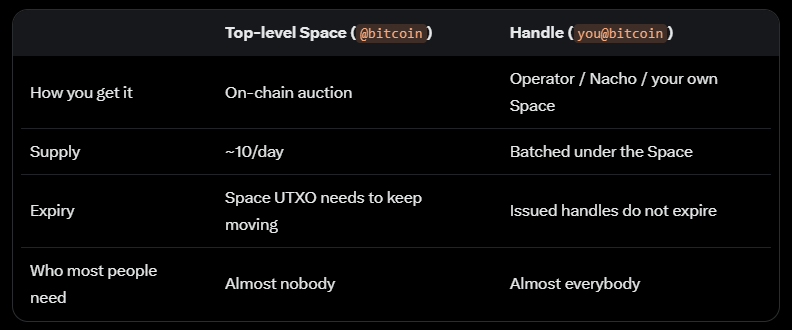
If you only want a name you can say at a bar, you want a handle. If you want to run a namespace — a brand, a city, a file type, a family — you bid on a Space.
Handles on mainnet: the part the first video was waiting for
The January 2025 walkthrough was looking at auctions and docs and guessing the rest. The rest shipped.Spaces v0.4.2 put the off-chain issuance layer on Bitcoin mainnet. The first production operator is @bitcoin. Handles go out through atbitcoin.com and the Nacho app on iOS and Android. Under @bitcoin the price has been a flat $25, once, first come first served. No annual ICANN bill for that handle.
spacesprotocol.org Nacho is easy to misunderstand. It is a keystore and resolver, not a send/receive Bitcoin wallet. It generates keys on the device, registers the handle, and lets you publish records:
- Bitcoin, Lightning, Liquid, Ark, Silent Payments
- Nostr, X, GitHub, Telegram, a website, a Tor address
- Keys you actually use — PGP, SSH, and so on
Change the Lightning invoice next year. The name stays. Look someone up on the phone; verification happens on the device against a trust anchor, not because a startup said so.
spacesprotocol.orgThat is the adoption product. Auctions are for collectors and operators. Nacho is for humans.
Why this is more than “another Lightning address”
People will point at BIP-353 and stop listening. They are half right.BIP-353 is the correct standard for wallets that already exist. [email protected] → DNSSEC → payment URI. Phoenix and friends will implement that before they implement Spaces. If your only pitch is “send sats to a cute name,” BIP-353 closes the slogan.Spaces still has a job BIP-353 cannot do:
- The name is not DNS. No registrar rewrite of the TXT. No expired card on file.
- One handle, many records. Pay, Nostr, site, new chat app after the last one banned you.
- You can live without Chrome. A Spaces-aware browser can resolve docs@space to nsite / Blossom content. DNS optional. The public web stays. A second room opens.
- Handles don’t expire after issuance. The parent Space is what you keep alive.
Say it in verbs, not adjectives. “Sovereign” is true and empty. “Your Telegram died and the name still points at the new room” is why someone installs Nacho.
The obvious use cases (the ones that actually get used)
Say the destination. pay@alice at a conference table beats a 62-character address. The wallet should pick the rail — on-chain, Lightning, Silent Payments — the way Robin Linus sketched. That UX is how this leaves the lab.Survive the ban. Publish the new account under the same handle. Friends look you up once. This is the story Andrew told after Telegram.Nostr without NIP-05. NIP-05 is DNS with a JSON file. NIP-SPACES is the same checkmark shape anchored to Bitcoin. Clients that show name@bitcoin instead of npub1… will do more for adoption than another white paper.A page that isn’t a domain. Point the handle at a site, or at nsite so the page isn’t one VPS. The name can outlive the host. The files still need someone seeding them. Be honest about that trade.A Space as a neighborhood. @pdf, @login, @payme are category words. @yourbrand is a company directory. You issue the handles. You don’t become ICANN; you become the person who decided the street names.
How to get involved without buying a dictionary
- Read the source of truth: spacesprotocol.org
- Watch live auctions: explorer.spacesprotocol.org
- Get a handle: nacho.io or atbitcoin.com
- If you run a node, run spaced / space-cli and resolve yourself
- If you build, Fabric SDKs resolve handles in the browser
You do not need to win @bank. You need one name you will actually put on a card.Secondary market exists at spaces.market. Treat floors like ENS floors: noise until wallets resolve the name. Collecting is allowed. Collecting is not adoption.
Objections worth answering
“This is just ENS on Bitcoin.”
ENS proved people want speakable names. It also proved they will park them. Spaces burns auction bids, caps daily issuance, and refuses a separate chain. The bet is that Bitcoin as root of trust is the only namespace people will put payment on. That bet can still lose if no wallet adds the field.“Why burn bitcoin?”
Because the alternative is paying a company to be ICANN. Burn is ugly and fair. Lost coins raise everyone else’s share. Squatters pay real BTC.“Certrelay is a new master.”
Relays store signed data. Clients verify the certificate against the on-chain root. If every relay vanishes, you still have the file and the seed. You can put fallback records on a num UTXO if you want the chain itself to carry the pointer. Most people won’t. The path exists.“I already have BIP-353.”
Keep it. Use Spaces for the identity that should survive the domain. They are not enemies. One is payments on DNS. One is a name that isn’t DNS.
Why the first video called it obvious
The January 2025 walkthrough wasn’t a protocol review. It was a Bitcoiner noticing the rhyme.Money without a custodian felt impossible until it shipped. Domains without a registrar feel the same way now. Incumbents always look permanent. The dollar didn’t vanish. It became optional for people who needed an exit. DNS will not vanish. It can become optional for the name on the invoice.Spaces Protocol will not get adopted because a blog post used the word sovereign. It gets adopted when someone says you@bitcoin out loud, a wallet understands it, and the page still loads after the domain dies.That is the whole product. Bitcoin for the coins. Bitcoin for the name. Same chain. Different job.Start here: spacesprotocol.org
Look up a name. If it resolves, you’re already late in the only way that matters — the good way.Further watching: the original first-look that framed this argument — BITCOIN SPACES PROTOCOL on curious@bitcoin — plus the later founder conversations if you want the 32-byte root explained by the people who wrote it.