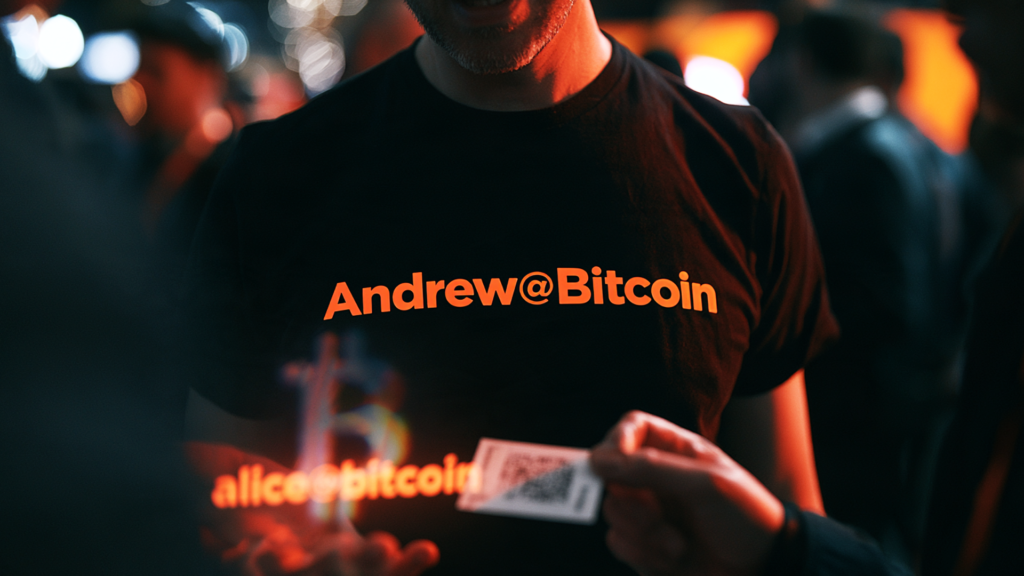
Bitcoin conferences have always been places where ideas travel farther than official sessions. In the video “Planting Bitcoin Seeds” from the curious@bitcoin channel, one builder describes exactly how those informal moments are being used to introduce Spaces Protocol. At a recent event he prepared physical cards carrying QR codes that pointed to a workshop and further resources. On the first day he wore a suit for the more formal side of the conference. On the second day he switched to a custom shirt that simply read Andrew Bitcoin. People noticed. They asked what it meant. Each question became a short explanation, and each explanation ended with a card left in someone’s hand. Even if the person never made it to the workshop, they walked away with a concrete next step and a reminder.
Spaces Protocol has existed for roughly a year and, at the time of the discussion, roughly 3,492 top-level Spaces had been registered. The number is still small. Most Bitcoin users have never heard of it. The protocol burns the Bitcoin used in auctions rather than sending it to any company or foundation. There is no entity that can be pressured or that stands to profit from a sudden change in rules. These design choices remove several common objections, yet they do not automatically create awareness. Awareness still has to be planted, conversation by conversation.
Connecting Names to Bitcoin’s Immutable Record
One of the more interesting exchanges happened during a session with Jeff Booth. The talk touched on Bitcoin and time. In the Q&A the speaker referenced Orwell’s line that whoever controls the past controls the future, then pointed to Julian Assange’s observation that blockchain records change the equation. Once an event or piece of information is anchored to the chain, later rewriting becomes far more difficult. He extended the idea to names and identifiers. Placing a human-readable handle on Bitcoin means the mapping itself benefits from the same global energy network that makes Bitcoin hard to alter. Booth leaned in. The connection was clear even though the protocol name was not mentioned in the question. After the session the speaker shook hands with the panelists. Whether that particular conversation leads to a longer discussion later is unknown. The point is the pattern: short, precise links between Bitcoin’s strongest properties and the practical problem of digital naming.
These moments matter because they frame Spaces Protocol as an extension of Bitcoin rather than a separate project. The security model is Bitcoin’s proof of work. The scarcity of top-level Spaces comes from a deliberate daily limit of ten rollouts. The permanence of individual handles comes from Merkle commitments whose roots are recorded on-chain. Once a handle is issued and the root is confirmed, no operator can revoke it. The user holds the keys and the certificate. That combination of properties is easier to explain when it is tied to ideas people already accept about Bitcoin.
Early Stage Reality and the Next Challenge
The video is candid about the current stage. The protocol has moved past the period when only a small group of people could experiment with it. Mainnet is live. Tools such as Nacho allow ordinary users to obtain and manage handles without running a node. Yet most people still have no idea the system exists. Browser integration is incomplete. Typing a Spaces name into a standard address bar does not yet resolve. Nostr relays and clients have only begun to explore native support. These gaps are normal for an early naming layer, but they also define the work that remains.
The speaker notes that previous efforts, including a workshop at an earlier TABConf, reached a friendly audience at a time when full functionality was not yet available. Now the foundation is in place. The limiting factor has shifted from protocol readiness to ecosystem density and public awareness. Builders are explicitly invited to start adding functionality. One example already visible in community chats is a Reddit-style interface that uses Spaces names. Others are working on wallet features, resolution libraries, and marketplaces that let Space owners set prices and issue handles while receiving payment directly. The invitation is practical: the core developers cannot build every integration. Anyone who sees value in permanent, Bitcoin-anchored names can contribute tools, documentation, or simply conversations that introduce the idea to new people.
Making Ownership Useful
A recurring theme is that enthusiasm alone is not enough. Space owners need reasons to keep developing their namespaces. The speaker has already built backend infrastructure that can support issuance and sales so that the roughly 3,500 existing Spaces can become productive rather than merely registered. Profitability does not require extracting value from users through renewal fees. Handles, once issued, do not expire. Revenue can come from the initial sale of handles, from optional services that Space operators choose to offer, or from applications that make the names useful for payments, profiles, or community membership. The burned-bid auction design keeps the distribution of top-level Spaces fair and removes the appearance of a team enrichment scheme. That clarity helps when explaining the system to newcomers who have seen other naming projects tied to tokens or ongoing rents.
For individual users the value proposition is already available. A handle obtained through a mobile app stays under the user’s keys. Records such as Bitcoin addresses, Lightning endpoints, Nostr npubs, or websites can be updated at any time. The name itself does not change and cannot be taken by a platform. In a conference setting that property is easy to demonstrate: show a name, show that it resolves, show that the keys are on the device. The physical card and the shirt simply start the conversation that leads to that demonstration.
From Seeds to Network Effects
Grassroots distribution has always been part of Bitcoin’s growth. Early adopters explained the idea in person, shared links, and accepted that most conversations would not convert immediately. Spaces Protocol is following a similar pattern at a smaller scale. The cards, the shirts, the short explanations that connect naming to immutability, and the open invitation to builders are all ways of increasing the surface area of the idea. Each person who leaves with a QR code or a remembered name becomes a potential future user, Space owner, or developer.
The numbers remain modest because the work of awareness is still early. That modesty is also an opportunity. Names that would be expensive or contested in a mature system are still obtainable. Integrations that would be crowded later can still be first. The protocol’s design already removes several failure modes that have slowed other naming systems: no token, no renewable rents for handles, no central party that receives auction proceeds, and verification that can be performed against Bitcoin itself. What remains is the ordinary work of showing people why those properties matter and giving them simple ways to use them.
The foundation has been laid. The next phase is awareness and ecosystem building. Conferences, meetups, online discussions, and direct outreach all serve the same purpose: planting the idea that a name can be held the way bitcoin is held. When enough people have seen a working example, tried a handle, or built something on top of the protocol, the network effects that naming systems require begin to appear. Until then, the most effective step is the one already being taken: short conversations, useful cards, and an open invitation for anyone who wants permanent, Bitcoin-secured identities to help grow the system.
Spaces Protocol Ecosystem Links
Spaces Protocol: https://spacesprotocol.org/
Explorer: https://explorer.spacesprotocol.org/
Marketplace: https://spaces.market/
GitHub: https://github.com/spacesprotocol
Akron Wallet: https://akron.io/
Nacho (iOS / Android): https://nacho.io/
Bitcoin handles: https://atbitcoin.com/
Documentation: https://spacesprotocol.org/docs/
White paper: https://spacesprotocol.org/paper