A Bitcoin address is a name that forgot to be a name. It is sixty-two characters, a checksum, and a prayer that the paste survived. People send life savings through that string because nothing better sat on Bitcoin. Spaces Protocol is the missing name. A space is a community identifier, held as a coin. A handle under it is a person, a shop, or a node that a stranger can say out loud. The auctions are open. The bids burn. The proof checks against the chain.
Community identifiers, not rented domains
The video “Bitcoin Spaces are Community Identifiers” starts from the comparison that actually matters. A space is the Bitcoin version of a top-level name. @bitcoin sits where .com sits, except the record is a UTXO. The key that can spend the output is the key that owns the name. There is no registrar renewal desk above it.
About 3,600 spaces are released each year. Ten a day move from pre-auction to a ten-day auction. Anyone can bid. A last-minute bid extends the clock, so sniping does not win by default. The winner claims the output. After that, the name moves like any other coin: transfer it, hold it, or hand the operator role to another key. The cap is the product. A namespace with no limit fills with lookalikes. A namespace with a daily auction makes a short name cost attention.
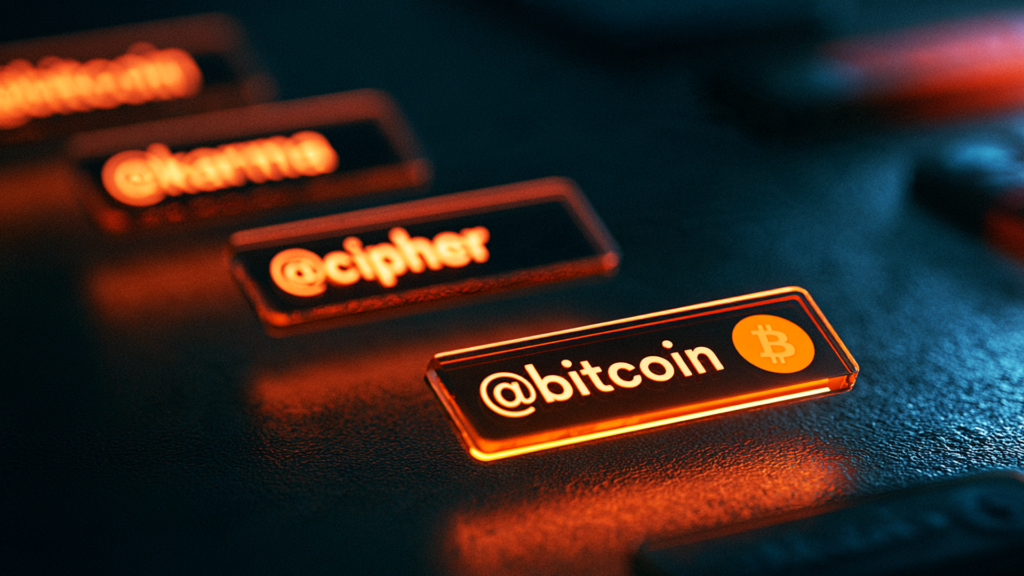
Early rollouts in that video were still cheap. A name like @4k cleared around 4,000 sats. Numbers and punycode were going for less, because almost no one was bidding. @karma, @ye, @uk, @matrix, @cipher, @happy were on the board or just off it. That window is the point of the video. The mechanism was live. The crowd was not. The names that look obvious later are the ones nobody fought for while the mempool was empty.
Why the bid is burned
A naming auction that pays a company is a land sale. Spaces burns the bid. The sats in the winning output are destroyed. They do not fund a foundation, a premine, or a team wallet. The video puts it in plain language: this is real bitcoin, gone, joining the coins that will never move.
That single rule changes the incentive. The protocol cannot farm the namespace. An operator can charge for handles under a space they won. The chain does not take a cut of the auction. There is no premium tier sold by the inventors. Scarcity is the release schedule, not a token supply.
Other Bitcoin-branded name systems took a different road. RSK and Stacks put names on a sidechain or a bridged asset. The name is only as final as the bridge, the sequencer, or the token vote. Spaces skips that. No wrapped coin, no slashing, no optimistic challenge window. The space is a UTXO on Bitcoin. A subspace, once allocated, can be taken on-chain by its holder. The operator cannot quietly edit it back.
Handles under the name
A space is the place. A handle is the door. alice@bitcoin. shop@markets. node@bitsaga. The operator maintains a Merkle tree of handles and commits a 32-byte root to Bitcoin. One root covers as many names as the operator wants to issue. The chain stores the fingerprint, not the phone book.
A wallet that wants to pay the handle asks a relay for a proof. The proof is a few kilobytes. The wallet checks it against the root Bitcoin already confirmed. The relay can be slow. The relay can vanish. It cannot substitute a different payment address, because the check is the chain. Records on the handle can point at a Bitcoin address, a silent payment code, Lightning, a site, a Nostr key. The payment destination can rotate without a new on-chain name.
This is the adoption surface. People do not memorize addresses. They memorize names, then they trust whoever resolves them. DNS resolves through a tower: registrar, registry, ICANN. BIP-353 and NIP-05 inherit that tower. They are useful, and they are rented. A .com can be seized, refused at renewal, or rewritten. A handle checked against a UTXO cannot be rewritten by a committee.
Subspaces do not have to trust the operator after allocation. If the holder wants, they can do the transfer, the key rotation, and the spend on-chain, the same way a top-level space moves. Most people will not need that. The option is the sovereignty. A username that can be revoked is an account. A handle that can outlive the operator is a name.
What a wallet has to do
The protocol is ahead of the readers. Auctions have been clearing. Handles can be issued. The explorer shows the output, the burn, and the claim. Nacho gives a holder a way to keep the key on a phone. Almost no mainstream wallet treats alice@bitcoin as a destination yet.
That gap is the work, and it is smaller than it sounds. Resolve the handle. Fetch the proof. Check the root against a node. Show the payment record. Hide the 62-character string. A merchant prints the handle on an invoice. A podcaster says it once. A node runner puts it in a bio. None of that needs a new token or a vote.
Verification was designed for small devices. A pruned node can follow the protocol. A phone can check a proof the node already accepts. Zero-knowledge light clients are the long path, so a wallet does not have to carry the whole history to know a name is real. The trust anchor is Bitcoin’s proof of work, not a company’s database.
Early is the feature
The video’s tone is the right one. The speaker is not certain the names will matter, and he is watching people pick up numbers while they are cheap. That is how a namespace starts. The famous words get bid up later, after a wallet makes them useful. The odd words, the short numbers, the community names, go to whoever showed up.
@happy as a space is not a joke. It is a place handles can live. @uk is a place. @cipher is a place. A family, a meetup, a shop, a city channel. One UTXO, many handles, one root. The operator issues. The holder keeps the key. The payer checks the proof.
Fees in those early claims were ordinary. A few thousand sats for a name, plus a miner fee at a few sats per virtual byte, while block space was quiet. Later auctions for obvious words cost more, because more people can see the use. That is the market a registrar used to run in private. Here the bids are public and the proceeds are burned.
The name is the product
Bitcoin made value movable without a bank. It left the destination as a string no human can read. Spaces puts a name on that destination without putting a company in the middle. The space is a coin. The handle is a proof under that coin. The auction is open, capped, and burned.
Adoption is a send button that accepts the name. Until then, the names are still being claimed, ten a day, by whoever bothers to bid. The video’s advice holds. If the idea is right, the cheap names are the ones on the board now, not the ones everyone can already pronounce.