
When the Bitcoin mempool nearly clears out, something fundamental is happening on the network. Fees drop to a few sats per virtual byte. Blocks fill with almost nothing. Yesterday the queue of unconfirmed transactions sat near empty, with only a few thousand transactions waiting roughly four blocks of activity. For a protocol built on proof-of-work and open settlement, that silence raises a practical question: if almost no one is using the base chain for meaningful work, what is Bitcoin actually doing right now?
The observation in the video “BITCOIN SPACES | EMPTY MEMPOOL” is straightforward. An empty or near-empty mempool is not automatically good. High usage on the base layer means people are settling value, registering ownership, and anchoring important data under Bitcoin’s security model. Low usage can signal that most activity has moved elsewhere. Second-layer systems such as Lightning handle high-volume payments well, and they reduce pressure on the chain. That is useful. But for long-term wealth storage and for any claim that needs to remain independently verifiable for years, the base layer still matters. A name or identity that lives only on a layer or a company database can be frozen, changed, or removed. A name anchored to Bitcoin cannot.
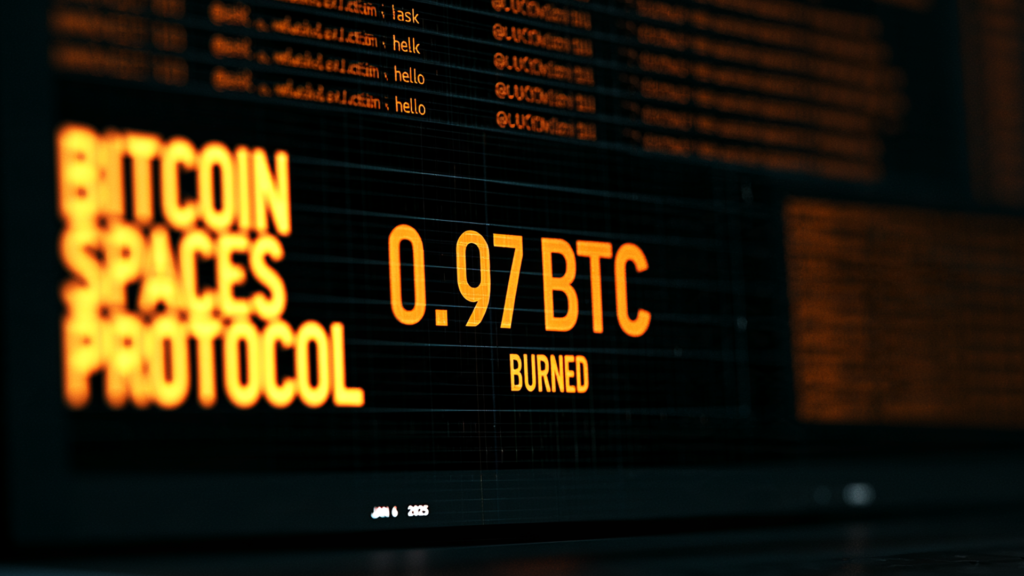
Spaces Protocol exists to put useful, lasting activity back on the base chain without bloating it. It is a naming system native to Bitcoin. Top-level spaces (community identifiers such as @bitcoin) are distributed through open auctions held on the Bitcoin blockchain itself. The highest bids win. The proceeds are burned via OP_RETURN so no foundation or company keeps the money. The burn makes Bitcoin slightly more scarce for everyone who already holds it. Sub-handles (examples: alice@bitcoin or curious@bitcoin) are issued under a top-level space. Most of the data stays off-chain in a Merkle tree. Only a 32-byte root is committed to Bitcoin. One small commitment can cover hundreds or thousands of handles. The on-chain footprint stays tiny even as the number of names grows large.
This design directly addresses the underuse problem visible in an empty mempool. Every auction and every commitment is a real Bitcoin transaction that pays fees and settles under proof-of-work. The activity is not spam. It is the registration of sovereign identities that people will use for payments, social profiles, wallets, and applications. Once a handle is issued and its root is confirmed, the owner holds a certificate and an inclusion proof. Anyone can check that proof against the Bitcoin blockchain. No registrar can refuse renewal. No platform can seize the name. The keys stay with the user and the name does not expire.
In the video the speaker notes ongoing burns and registrations. At the time of recording, more than one Bitcoin had already been burned through the auction process and hundreds of spaces had been registered. New names continue to roll out, including ordinary words and punycode strings that support international characters and symbols. Punycode looks opaque at first (strings beginning with xn--), but it is simply the standard way to encode non-ASCII characters so they can exist as valid identifiers. The protocol does not restrict language or script. Anyone can bid on a name that makes sense in their community.
The practical result is a handle that works the way a good username should. You can point alice@bitcoin at a Bitcoin address, a Lightning invoice, a Nostr npub, a website, or any other record you choose. Wallets and applications that understand the protocol resolve the name and verify the proof locally. The user experience is closer to typing a short handle than to copying a long address or npub. Because the root lives on Bitcoin, the resolution remains valid even if a particular relay or website is offline. Ownership does not depend on any single company staying in business.
Compare this to traditional domain names. A .com or country-code domain is a lease. You pay a registrar every year. The registry can refuse to renew, seize the name for policy reasons, or change the records. The person who holds the domain does not hold a private key that proves ownership against a public ledger. Spaces reverses that model. The top-level auction is permissionless and on-chain. The sub-handle, once issued, is controlled by the holder’s keys. The certificate and inclusion proof are sufficient to prove ownership to anyone who can see Bitcoin. There is no annual fee and no third party that can revoke the name after the root is confirmed.
The empty-mempool moment makes the distinction clearer. Lightning and other layers are excellent for moving small amounts quickly. They are not the best place to store the keys that represent long-term wealth, nor are they the natural place for an identity that should outlast any particular company or client. Bitcoin’s base layer is the strongest settlement and timestamping system available. Using it for naming does not require large data or frequent transactions. A single 32-byte root per batch of handles is enough. The rest of the system scales off-chain while the security root remains on Bitcoin.
Early adoption is already visible in the numbers the video references: continuing registrations, burns measured in whole Bitcoin, and daily rollouts of new names. Tools exist to make the process straightforward. The official explorer at explorer.spacesprotocol.org shows live auctions, registered spaces, and recent activity. The Nacho app on iOS and Android lets users manage handles from a phone without running a full node. A marketplace at spaces.market supports secondary sales of existing names. Developers can resolve names with a few lines of code using the open-source SDKs. All of these pieces sit on top of the same Bitcoin-anchored roots.
The broader implication is simple. Bitcoin becomes more useful when people can refer to each other by short, human-readable names that are as hard to take away as the coins themselves. An empty mempool is a reminder that the base layer can do more than process occasional large transfers. It can also serve as the permanent root of trust for identities that people actually use every day. Spaces Protocol is one concrete way to add that activity without changing Bitcoin’s rules or increasing its data burden.
The protocol is live. Auctions continue. Handles continue to be issued. The same security model that protects Bitcoin now protects the names built on top of it. For anyone who has watched fees drop and blocks go quiet, the next logical step is to put something valuable on the chain that will still matter years from now. A sovereign Bitcoin name is exactly that.
Claim or bid on a name today and put real, lasting activity on Bitcoin.
- Official site: https://spacesprotocol.org/
- Live auctions and explorer: https://explorer.spacesprotocol.org/
- Marketplace: https://spaces.market/
- Nacho app (iOS / Android): https://nacho.io/
- Bitcoin handles directory: https://atbitcoin.com/
- Akron Wallet: https://akron.io/
- Orbee Chat: https://orbee.chat/
- NIP-SPACES draft: https://github.com/buffrr/nips/blob/spaces/NIP-SPACES.md
- GitHub: https://github.com/spacesprotocol
Not your keys, not your name. Get yours while the auctions are still early.