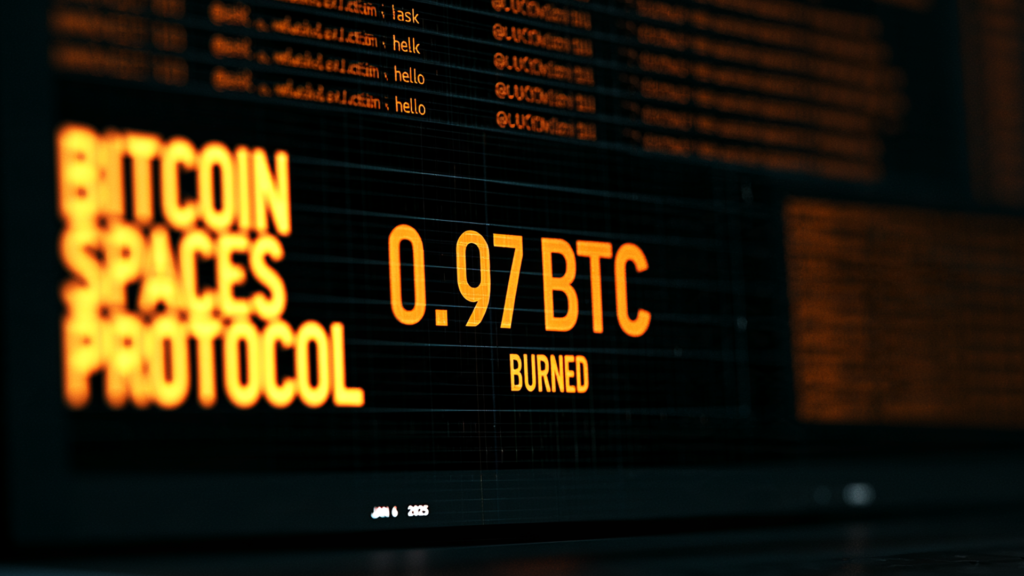
Bitcoin sits near 99,000 dollars with low fees and a quiet mempool. In that same window the Spaces Protocol continues to record real activity. Bids land on names. Transfers settle. New sets of identifiers roll out on Bitcoin block time. The short daily update titled “Navigating the World of Bitcoin” captures one of these ordinary days: multiple bids on punycode strings, double-letter names drawing attention, a triple-zero entry advancing, and fresh rollouts that include ordinary words alongside encoded international characters. The activity is small in absolute terms yet consistent. It demonstrates that people are already treating Bitcoin as the root for human-readable names rather than waiting for a future release.
Spaces Protocol is a naming system built directly on Bitcoin. Top-level spaces function as community identifiers. Roughly 3,600 of them can be distributed each year through open auctions. Anyone can bid. The highest bid at the close of the auction wins. The proceeds are burned so no foundation or company receives the money. Once a space is won, its owner can issue sub-handles such as alice@bitcoin or curious@bitcoin. Most of those handles are created off-chain and grouped into a Merkle tree. Only a 32-byte root is committed to Bitcoin. The holder receives a certificate and an inclusion proof. Anyone can check that proof against the confirmed root. The name does not expire. No registrar can refuse renewal or seize the record after the root is on chain.
The video highlights the practical side of this process. Bids appear on short encoded strings that look like xn-- followed by letters and numbers. These are punycode representations of characters that fall outside basic ASCII. They allow names that use Chinese, Arabic, emoji, or other scripts. In the update the speaker notes bids on several of these, along with transfers and a cloud auction that has already drawn more than thirty bids totaling hundreds of thousands of satoshis. Double-letter combinations are drawing notice because single letters and digits have already been claimed. A triple-zero name has entered the pre-auction stage after a modest bid. The speaker points out that the bidder’s address holds a larger balance, raising the ordinary question of how far any single participant will push. These details matter because they show ordinary market behavior on an open ledger rather than a closed allocation.
Rollouts themselves follow Bitcoin’s block cadence. A new set of names becomes available after a certain number of blocks, not at a fixed clock time. In the video one rollout occurred on block 882,289 and included both ordinary words and additional punycode entries. The next set is scheduled roughly a day later. Because the schedule is tied to the chain, participants cannot game it by waiting for a particular time zone. Everyone sees the same blocks. The result is a transparent, recurring opportunity for new names to enter circulation without a central party deciding who receives them.
This design produces several concrete advantages. First, ownership is cryptographic. The person who holds the keys and the certificate can prove control to any verifier that can see Bitcoin. Second, the on-chain footprint stays small. Millions of handles can be issued while only a handful of 32-byte roots are written to the chain. Third, the auction mechanism distributes scarce top-level names without a first-come-first-served land rush and without directing proceeds to any single organization. Fourth, the system works for global users. Punycode support means a name that is natural in one language or culture can exist as a valid identifier. Fifth, the same handle can point to multiple records: a Bitcoin address, a Lightning invoice, a Nostr public key, a website, or any other data the owner chooses to publish. Wallets and applications that understand the protocol resolve the name and verify the proof locally.
The activity recorded in the video is still early. Single letters and digits are gone. Double letters are popular. Triple letters are beginning to appear. Punycode strings continue to attract bids even when their visual form is unfamiliar. A cloud auction is drawing dozens of participants. These patterns resemble the early stages of other scarce digital namespaces. They also differ in one important respect: every bid and every commitment is a Bitcoin transaction that pays fees and settles under proof-of-work. The activity is not external to the network. It is additional, purposeful use of the base layer for something people actually want: short, permanent names.
For builders the practical path is already open. An explorer shows live auctions, registered spaces, and recent actions. Mobile applications let users manage handles from a phone. A marketplace supports secondary sales of existing names. Developers can resolve a handle with a few lines of code using open-source libraries. Because verification returns to Bitcoin, an application does not need to trust any particular relay or website. If the owner supplies the certificate and the root is confirmed, the name is valid. Users who want zero external dependency can still place fallback data on-chain. The protocol does not require a new chain or changes to Bitcoin itself.
The larger implication is that Bitcoin can serve as the durable root for identifiers the same way it already serves as the durable root for value. A name on a company platform can be frozen or deleted. A name rooted in a 32-byte commitment on Bitcoin remains available as long as Bitcoin does. The daily updates show that people are already placing bids, completing transfers, and watching rollouts. The numbers are modest today. The mechanism is live and permissionless. The same properties that make Bitcoin hard to censor now apply to the handles people will type and share.
The next useful step is participation. Bid on a name that fits a project or community. Issue or claim a sub-handle and point it at the records you want others to find. Share the short handle instead of a long address. Because the root lives on Bitcoin, the name stays with the keys even if any particular app or service disappears. The activity visible in ordinary daily updates is the early evidence that this process is already underway.
Claim a name and join the activity
Official site: https://spacesprotocol.org/
Live auctions and explorer: https://explorer.spacesprotocol.org/
Marketplace: https://spaces.market/
Nacho app (iOS and Android): https://nacho.io/
Bitcoin handles: https://atbitcoin.com/
Akron Wallet: https://akron.io/
Orbee Chat: https://orbee.chat/
NIP-SPACES: https://github.com/buffrr/nips/blob/spaces/NIP-SPACES.md
GitHub: https://github.com/spacesprotocol
Not your keys, not your name. The auctions and rollouts continue on Bitcoin time.