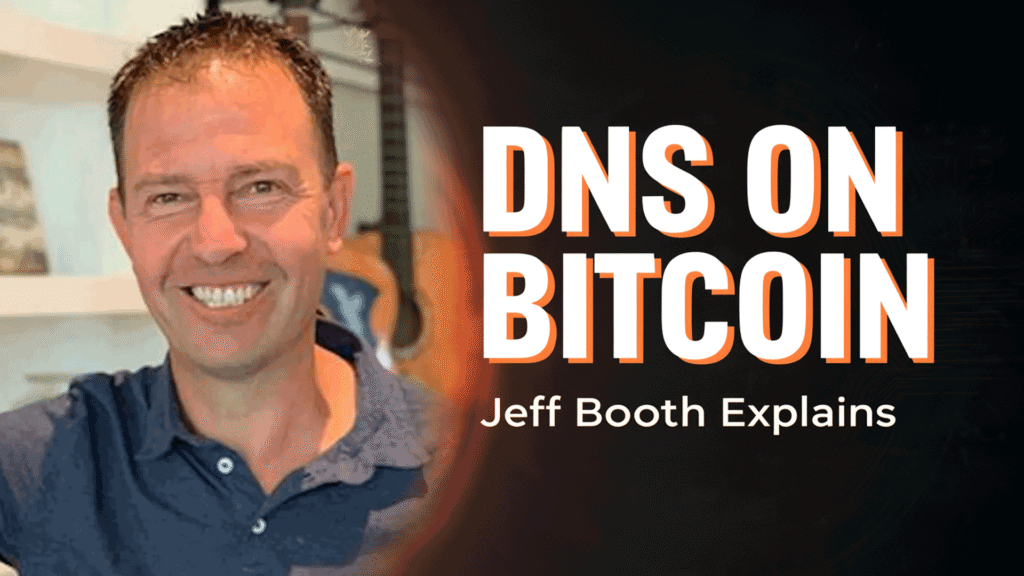
The missing piece of a truly sovereign internet has always been the name itself. Jeff Booth has long argued that Bitcoin does not merely change money; it forces every layer of the digital stack to confront the same choice between permission and freedom. In a discussion with Bitcoin Chris, highlighted by the channel curious@bitcoin, Booth returns to DNS on Bitcoin and the role of Nostr. The observation is simple and sharp: Nostr already functions as a kind of social DNS, yet the underlying naming systems people still rely on remain centralized, revocable, and ultimately controlled by registrars, certificate authorities, and platform operators. The video points directly at the practical answer already live on Bitcoin mainnet: Spaces Protocol.
Spaces Protocol is a sovereign naming system native to Bitcoin. Handles such as alice@bitcoin live primarily off-chain, while Bitcoin’s proof-of-work anchors the trust. No new token, no bridge, no slashing, no optimistic security model, and no soft fork. The result is human-readable Bitcoin identities, Nostr usernames, wallet names, and payment destinations that are as hard to censor as the chain itself.
Why Centralized Naming Keeps Failing Bitcoin Users
Traditional DNS was never designed for adversarial environments. Domain seizures, registrar freezes, and ICANN-level policy changes have repeatedly demonstrated that a name registered through conventional channels can be taken away. Even well-intentioned “decentralized” naming systems often reintroduce trust at the edges. ENS, for example, is powerful on Ethereum, yet most production integrations resolve names through centralized gateways. Users trade one set of intermediaries for another and still pay gas on a chain whose security budget and finality assumptions differ from Bitcoin’s.
Nostr faces a related constraint. NIP-05 verification ties a human-readable identifier to a domain and therefore back to the existing DNS and certificate stack. When those systems are pressured, the social graph feels the pressure. Jeff Booth’s point in the discussion is that attacks on centralized layers do not destroy the open alternative; they reveal it. Federated experiments have been shut down precisely because they retained a center. The free-market response is systems that remove the center entirely.
Spaces Protocol is built for that response. Primary spaces are community identifiers acquired through open auctions on Bitcoin. Subspaces (the everyday handles) are issued inside those communities and, once allocated, cannot be revoked by the operator. Verification does not require trusting a website or an API. A client can check the Bitcoin-anchored state root and the accompanying Merkle proofs locally.
How Spaces Protocol Actually Works
The protocol runs a three-stage pipeline that stays inside Bitcoin’s existing rules.
Top-level spaces such as
@bitcoin (atbitcoin.com) are distributed by permissionless auctions. Up to ten spaces roll out each day, roughly 3,600 community spaces per year. Auctions last on the order of 1,440 blocks (about ten days). The highest bid at close wins. Crucially, the bid is burned. No foundation, no company, and no development team extracts rent from the auction. Scarcity is enforced by Bitcoin’s block cadence rather than by an administrator’s whitelist. There was no premine of names.
Once a space exists, its operator can issue subspaces in batches. Millions of handles can be organized into a Merkle tree whose 32-byte root is committed to Bitcoin. Each recipient receives an off-chain certificate that proves both inclusion and prior non-existence. The on-chain footprint stays tiny: one hash can cover an enormous namespace. Holders may also submit transactions directly on-chain if they prefer. After issuance, the operator cannot later reroute, recover, or revoke the handle. Expiration rules exist, but arbitrary seizure does not.
Resolution happens through an off-chain relay network (Certrelay) and client libraries. Apps ask for alice@bitcoin, receive the records and proofs, and verify them against the Bitcoin-anchored root. Fabric, the resolver SDK, ships for JavaScript, Rust, Python, Go, Swift, and Kotlin. A few lines of code are enough to integrate trustless name resolution. Trust Anchor further lets applications confirm identities directly against Bitcoin rather than a company server. A single Trust ID, derived from protocol state committed in Bitcoin blocks, is sufficient for a client to validate what it sees. The design explicitly targets zero-knowledge light clients so that even resource-constrained devices can check the chain of verification: Bitcoin proof-of-work, Merkle root, local mathematical proof.
The official site frames the outcome cleanly: your name, your keys. Names live off-chain; Bitcoin anchors trust. No authority can revoke what Bitcoin has confirmed.
Why This Design Creates Genuine Excitement
Scarcity without a landlord is rare. Burning auction proceeds removes the incentive for a protocol team to manufacture artificial demand or to capture ongoing fees from the namespace itself. Bitcoin remains the only currency required. That single property aligns the system with the cypherpunk preference for minimal new trust assumptions.
Scalability without a new chain is equally rare. Committing a 32-byte root that covers vast numbers of handles means the protocol does not bloat Bitcoin’s block space the way fully on-chain name systems can. A May 2026 update from the project noted a faucet capable of issuing on the order of 100 million handles, each still verifiable against the same class of Bitcoin commitment. Everyday users can claim a handle quickly; power users and communities can still operate with full on-chain options.
Sovereignty after allocation matters more than marketing slogans. Many naming systems advertise decentralization until the moment an operator, a multisig, or a governance vote decides otherwise. Spaces subspaces, once issued, do not require continued trust in the community operator. Users can move records, sign with the associated keys, and prove ownership independently. The protocol is designed so that a pruned Bitcoin node plus the Spaces client can reconstruct and verify state even on modest hardware such as an older Raspberry Pi without relying on a third-party resolver for the final check.
Comparison with existing options is straightforward. Against DNS and NIP-05, Spaces removes the registrar and the certificate authority. Against ENS-style systems, it anchors to the chain with the longest-running and most widely audited proof-of-work security, avoids bridges, and keeps the majority of activity off-chain while still permitting on-chain fallback. Against pure public-key sharing (npubs, raw Bitcoin addresses), it supplies memorable handles that remain cryptographically bound to keys the user controls.
Concrete Uses That Drive Adoption
Human-readable Bitcoin addresses are the most immediate win. Sending value to a name instead of a string of characters reduces error and lowers the social friction of onboarding. Wallets that resolve Spaces handles can display a verified badge once the user has pinned a Trust Anchor, making the difference between a checked sovereign identity and an unverified lookup visible.
Nostr integration is already specified. NIP-SPACES offers a sovereign alternative to NIP-05: identities anchored to Bitcoin and verified with Merkle proofs rather than DNS. Clients can treat a Spaces handle as the stable social identifier while relays continue to carry the events. Group chat experiments such as Orbee show what the social layer looks like when the name itself is not leased from a platform.
Personal sites and merchant pages follow naturally. Booth’s emphasis on individuals accepting Bitcoin for goods and services becomes simpler when the destination is a stable, self-custodial name. A creator, a circular-economy shop, or a Lightning-powered service can publish payment instructions, Nostr relays, and contact keys under one handle that no registrar can suspend.
Developers gain a small, embeddable PKI. The same verification path works for login, signed packages, access control, and cross-app identity. Because the heavy lifting of state commitment sits on Bitcoin and the proofs travel with the data, applications do not need to operate their own naming authority.
Getting Started and Spreading the Network
The project is live on mainnet. Documentation, a command-line client (space-cli), and the spaced daemon that talks to Bitcoin Core are available from the official repositories and spacesprotocol.org. Auctions for top-level spaces can be opened and bid on directly. Subspace handles can be obtained through community operators or the public faucet when available. Installing a Trust Anchor lets any supporting app move from “resolved somehow” to “verified against Bitcoin.”
Adoption compounds. Every wallet that resolves a handle, every Nostr client that prefers NIP-SPACES, and every merchant that prints a Spaces name on an invoice makes the next user’s experience smoother. Because verification is local and the auction proceeds are burned, growth does not enrich a central issuer. The incentive is simply that the name works, travels with the user, and survives pressure that would take down a conventional domain.
Jeff Booth’s broader thesis is that technology trending toward abundance collides with systems designed for control, and that Bitcoin is the release valve. Naming has been one of the last layers still rented from intermediaries. Spaces Protocol closes that gap with auctions whose fees disappear, handles whose proofs anyone can check, and an on-chain footprint small enough to leave Bitcoin’s monetary role untouched. The video’s suggestion is no longer speculative: the protocol exists, the clients exist, and the verification path runs back to proof-of-work.
Claim a handle. Pin a trust anchor. Resolve a name inside an app you already use. The sovereign namespace grows one verified identity at a time, and it is already open.
https://explorer.spacesprotocol.org/
In this video, Jeff Booth talks about the importance of DNS on Bitcoin and NOSTR. I make the connection that perhaps NOSTR can be used in the backend with relays and that Spaces Protocol could potentially be the solution we need to decentralize naming. Domain names, Digital usernames including NOSTR usernames, Human readable bitcoin addresses and more.
Link to full video. Video credit @BitcoinChris https://youtu.be/2Xeve_twLLQ