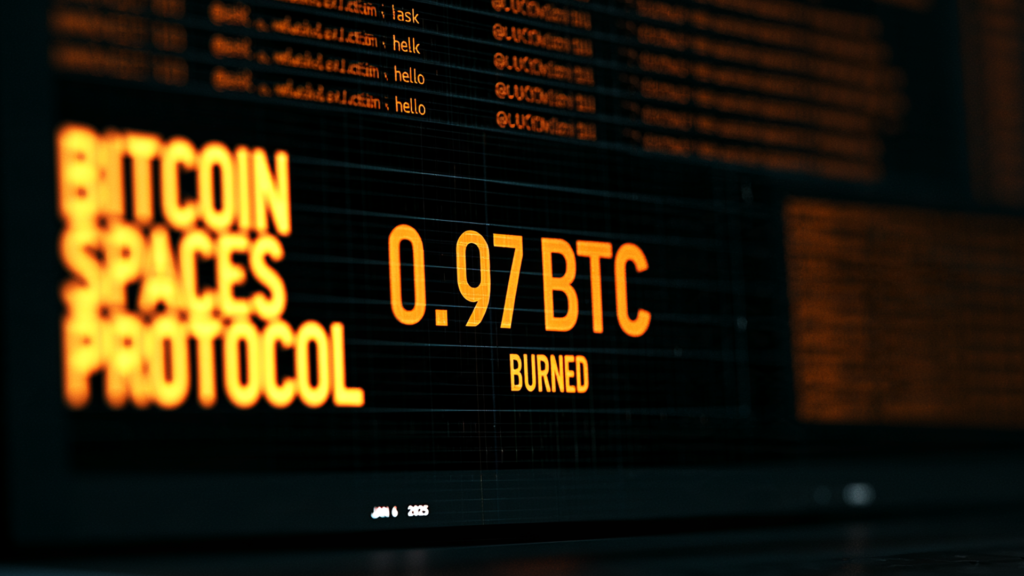

That is the number that jumped off a January 21, 2025 update from the channel curious@bitcoin, in a video titled “7 MILLION SATOSHIS.” The clip walks through live Bitcoin Spaces Protocol activity: rising fees, open auctions, transfers, and a top-level space called AI that drew 30 bids and cleared at 7 million satoshis. The host’s reaction was simple. It seemed like a deal.
That single auction is a useful window into why Spaces Protocol is starting to feel like the naming layer Bitcoin has been missing. Spaces are community identifiers, closer to .com or .org than to a social handle rented from an app. Each one is a Bitcoin UTXO. Under it, a community can issue millions of sovereign identities called subspaces. Supply is capped at about 3,600 community spaces a year, released through permissionless auctions on Bitcoin itself. No new token. No bridge. No company that can seize the name after the fact.
A live market, not a white paper
The video is not a keynote. It is a block-by-block look at a market that was already moving. The host notes the date, Tuesday, January 21, 2025, and the state of the mempool: low-end fees around 8 sats per vbyte, higher priority closer to 11, with cheaper slots still available. Bitcoin’s dollar price was swinging through the inauguration headlines, including a reminder that wrapped bitcoin on another chain is not bitcoin. Against that backdrop, Spaces activity kept printing.
Names in motion included punycode, Nomad, 4K, Cipher, Trinity, and God. Some were bidding. Some were transferring. Some were locking up. The explorer at explorer.spacesprotocol.org was the scoreboard. The host counted transfers and registrations, and noted hundreds of top-level spaces already secured. The standout was AI: 30 bids, 7 million satoshis, and the sense that early participants were still getting in ahead of wider awareness.
That is the adoption story in miniature. People were not waiting for a marketing campaign. They were bidding real satoshis, burning those bids under the protocol rules, and walking away with community identifiers anchored to Bitcoin proof of work. A name that can clear millions of sats in an open auction is no longer a thought experiment. It is a market discovering scarcity.
What a Space actually is
Spaces Protocol is a naming protocol native to Bitcoin. It does not ask for a soft fork, a sidechain, or a new consensus system. Top-level spaces are distributed by auctions built from existing Bitcoin scripting. Up to 10 spaces roll out each day. An auction runs for roughly 10 days, on the order of 1,440 blocks. The highest bid at the close wins.
The proceeds are burned. Official documentation is explicit: bids are permanently removed from circulation, and no entity profits from the auctions. That design choice matters. In most naming systems, the registry or the foundation captures the rent. Here the competition is for the name, and the satoshis leave circulation. Fair distribution is enforced by the auction and by the daily cap, not by a whitelist.
Think of a top-level space the way the video does: a community identifier, a sovereign version of a top-level domain.
The owner of that space can then issue handles underneath it.
alice@bitcoin is the everyday form.
alice is the subspace.
@bitcoin is the top level space.
Together they form a sovereign handle alice@bitcoin. The same pattern works for communities, apps, and payment destinations.
Unlike naming systems built on RSK or Stacks, or any of the other silly blockchains, a Space is a Bitcoin UTXO secured directly by the Bitcoin blockchain. There is no bridge to trust, no slashing condition, and no optimistic challenge window. Once the auction settles and the space is registered, the security assumption is Bitcoin’s.
Subspaces: millions of names, one small footprint
The scarcity sits at the top. The scale sits underneath.
Subspaces, also called handles or subs, are individual identities issued inside a space. The operator batches them into a Merkle tree and commits a 32-byte root to Bitcoin. One tiny on-chain footprint can cover an enormous namespace. A May 2026 project update described a faucet path in which on the order of 100 million handles could be committed against a single 32-byte tree root. The point is not the faucet itself. The point is the compression: Bitcoin anchors the root, and the handles live off-chain with proofs.
Each issued handle comes with a certificate. The certificate proves inclusion in the committed tree and proves the name was not already issued in a prior root. Recursive proofs can keep that certificate compact. After issuance, the handle is sovereign. The operator cannot revoke it, reroute it, or recover it. The holder can keep using it even if the operator disappears. If the holder wants every action on-chain, the protocol allows that path too. Trust in the operator ends at allocation.
That is the property the video description stresses, and it is the property that separates Spaces from rented usernames. A platform handle dies when the platform decides. A DNS name dies when a registrar, a court, or a policy team decides. A subspace, once allocated, is as hard to seize as the Bitcoin commitment it hangs from.
Verification is built for real devices. The protocol is designed with zero-knowledge light clients in mind, so a phone can check state without running a full node. A pruned Bitcoin node plus the Spaces client is enough for a stricter check, including on modest hardware. Fabric, the resolver, ships for JavaScript, Rust, Python, Go, Swift, and Kotlin. An app resolves alice@bitcoin, receives the records and proofs, and verifies them against the Bitcoin-anchored root. Trust Anchor lets that check happen without a company server in the middle.
Why this beats the naming systems people already know
Centralized DNS still runs the web, and it still fails in predictable ways. Seizures, registrar freezes, and policy takedowns are features of the system, not bugs. Nostr’s common human-readable verification, NIP-05, ultimately leans on that same DNS and certificate stack. NIP-SPACES is the sovereign alternative: identities anchored to Bitcoin and checked with Merkle proofs instead of a domain certificate.
ENS proved that people want readable names. It also showed the limit of resolving those names through gateways. A decentralized registry that most users query through a centralized API has moved the trust, not removed it. Spaces keeps the final check on Bitcoin proof of work. Clients can verify locally. There is no separate token to farm, and there was no premine of names.
Sidechain and federated naming systems inherit the trust of the sidechain or the federation. The video description draws the contrast directly: Spaces are Bitcoin UTXOs, not a Bitcoin-themed brand on another chain. When the host in the same update brushes off wrapped bitcoin as “not Bitcoin,” the same instinct applies to names. If the security budget and the finality are somewhere else, the name is somewhere else.
The burn is the economic tell. Valuable names will still be expensive. AI clearing at 7 million satoshis is evidence, not a promise. The difference is where the money goes. It does not capitalize a foundation treasury. It does not pay an ongoing renewal tax to a protocol company. It is destroyed. The winner keeps the community identifier. Everyone else keeps a scarcer bitcoin supply.
What people can actually do with a handle
Human-readable Bitcoin payments are the obvious first use. A wallet that resolves a Spaces handle turns a string of characters into a name a person can say out loud and check. Merchants, creators, and circular-economy shops can publish a stable destination that is not leased from a platform.
Social identity is the second. A Nostr client that prefers a Spaces handle over a DNS-tied identifier gives users a name that travels across relays. Group chat experiments such as Orbee show the social layer when the name itself is sovereign: signed events, verifiable handles, no registrar in the path.
Developers get a small public-key infrastructure. Login, signed records, access control, and package identity can all resolve through the same Fabric call. The on-chain cost stays in the commitment root. The user experience stays a name.
Communities get a registry they operate but do not own in the old sense. A space can issue handles for members, customers, or citizens of a circular economy. After issuance, those members do not depend on the operator’s continued goodwill. That is a better default than a Discord role or a subdomain that can be deleted overnight.
The video’s parade of names, from short dictionary words to punycode experiments, is what early internet land rushes looked like. Some names will be brands. Some will be jokes. Some will be infrastructure. The protocol does not need to pick. The auction and the daily cap do the sorting, and the burn keeps the sorting honest.
How to get in while the namespace is still young
The protocol is live on mainnet. The public site is spacesprotocol.org. The market the video was watching is explorer.spacesprotocol.org. Top-level auctions can be followed there in the open: pre-auctions, live auctions, claims, and transfers.
Anyone who only wants a handle does not need to run a node. Community operators and apps such as Nacho issue subspaces. A faucet path has also been used for experimentation, with the clear note that production handles come through a normal operator flow in which you hand over a public key and receive a certificate. Developers can install the Spaces client, point it at Bitcoin Core, and bid or resolve with space-cli and Fabric.
The practical loop is short. Watch an auction. Bid if the name matters. Or claim a subspace under a space that already exists. Pin a trust anchor in any app that supports one, so resolution is checked against Bitcoin rather than a website. Publish payment records, Nostr relays, or contact keys under the handle. Every wallet, client, and merchant that resolves the name makes the next resolution easier.
Scarcity is the clock. About 10 spaces a day means about 3,600 a year. Short names and obvious category names will not stay cheap. The AI sale at 7 million satoshis, 30 bids deep, is an early print, not a ceiling. Later auctions will clear higher as more wallets and Nostr clients treat these handles as normal.
The name layer finally matches the money
Bitcoin removed the issuer from money. Spaces Protocol removes the issuer from the name, without inventing a new chain to do it. Auctions are permissionless. Bids are burned. Subspaces, once allocated, do not ask the operator for permission again. Proofs verify against Bitcoin. The footprint stays small enough that the chain’s monetary role is left alone.
The January 2025 clip captured the moment that story stopped being theoretical. Fees were ordinary. Price was noisy. And underneath, people were bidding millions of satoshis for community identifiers that only Bitcoin can secure. That is the excitement worth sharing: a readable name, your keys, and a market that cannot be switched off by a registrar.
Open the explorer. Watch the next auction. Claim a handle. Resolve it in an app. The sovereign namespace is already open, and the early bids are already on chain.