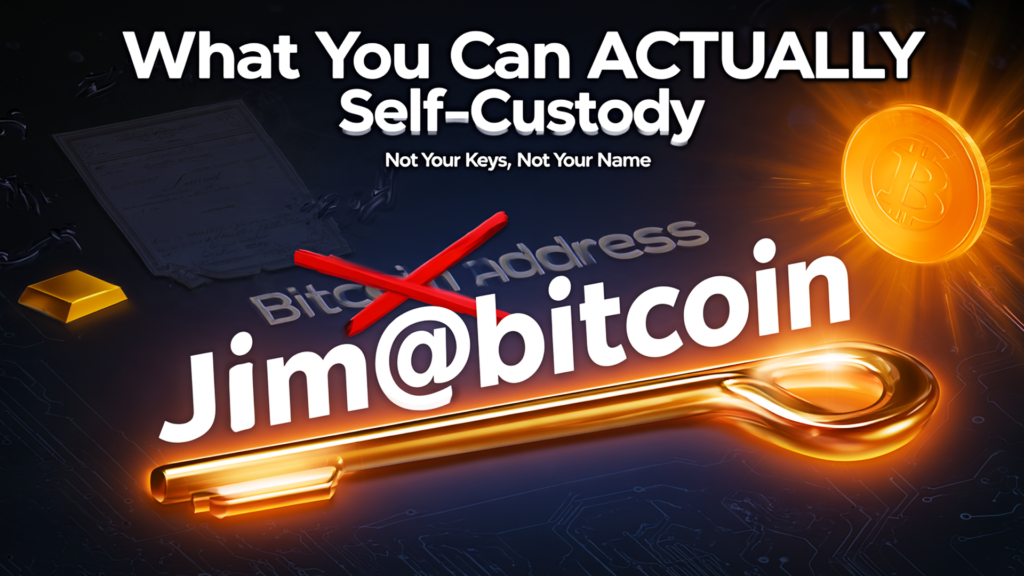
A video on the curious@bitcoin channel titled “What Can You ACTUALLY Self-Custody in 2026?”, the hosts examine a deceptively simple question. What assets can a person truly control without ongoing permission from governments, registries, or third parties? The conversation begins with gold. Holding a physical bar means the owner has it in hand. Physical force can still take it, but no central ledger decides ownership. Land comes next. Ownership of land appears straightforward until taxes, property records maintained by local governments, and the power of eminent domain enter the picture. Even after buying land outright with cash, the owner faces continuous obligations and the possibility that authorities will reassign the property for public purposes after a valuation exercise. Bitcoin stands apart. The protocol itself enforces ownership. Anyone can verify the chain independently. No authority must agree that a particular set of keys controls particular coins.
This distinction matters for Bitcoin adoption. For years the community has repeated “not your keys, not your coins.” The video makes clear that the same principle applies to any asset whose control depends on an external ledger or ongoing state permission. Gold offers physical possession but remains vulnerable to theft. Land offers legal title but remains subject to taxation on unrealized value and forced transfer. Bitcoin offers cryptographic possession that the network itself recognizes. The next logical step, and the one the channel consistently returns to, is applying the identical standard to digital names and identities.
Spaces Protocol supplies that standard. It is a naming system native to Bitcoin that requires no new blockchain and no modifications to Bitcoin consensus. Top-level Spaces function as community identifiers, similar in concept to top-level domains yet allocated through open, permissionless auctions conducted entirely on the Bitcoin blockchain. Bids are burned via OP_RETURN so that no company or intermediary profits from the process. The protocol limits new Spaces to roughly ten per day, or about 3,600 per year, preventing the rapid concentration that plagued earlier naming experiments. Once a Space is won, its owner controls a Bitcoin UTXO that represents the name. From that UTXO the owner can issue subspaces, also called handles, such as alice@bitcoin.
These handles operate primarily off-chain. The operator organizes them into a Merkle tree and commits only a compact 32-byte root to Bitcoin. Millions of individual identities can therefore exist under a single Space with almost no additional on-chain footprint. Each issued handle comes with a certificate that proves two facts: the name exists in the committed tree, and it did not exist in any prior root. The certificate remains valid indefinitely. The handle does not expire. The operator cannot later revoke it. Even if the operator disappears or the Space changes hands, the certificate continues to prove ownership. Users who desire full on-chain interactivity can bind a handle to a UTXO and perform key rotation or other operations with ordinary Bitcoin transactions. Verification does not require a full node. A zero-knowledge light client or simple Merkle proof checked against the Bitcoin-anchored root is sufficient. The system functions as a scalable, trustless Bitcoin certificate authority.
This architecture directly extends the self-custody argument presented in the video. A traditional domain name or social media handle is closer to land than to Bitcoin. Ownership exists only so long as a registrar, registry, or platform continues to recognize it. Renewal fees, terms-of-service changes, or government pressure can remove the name. A Spaces handle, once certified, is closer to Bitcoin itself. The cryptographic proof is held by the user. The root of trust is Bitcoin’s proof of work. No authority maintains a separate ledger that must be consulted or obeyed. Anyone can independently confirm that a particular public key controls a particular handle.
The practical consequences for everyday use are immediate. A single handle can publish current payment instructions: a Bitcoin address, a Lightning offer, a silent payment address, or details for Liquid or Ark. Senders resolve the name and receive the latest instruction without copying a long string of characters. The same handle can serve as a Nostr username, link to websites, social profiles, PGP keys, or any other records the owner chooses to publish. Records update freely while the name remains fixed. Because resolution occurs through a peer-to-peer relay network and every response carries a proof checked against the Bitcoin root, no central service sits in the path of verification. Developers integrate resolution in a few lines of code across multiple languages. End users obtain a handle through the Nacho app on mobile or through the spaces.market marketplace without running infrastructure.
The video’s discussion of land and eminent domain highlights why permanence matters. Human institutions change their minds. A name that can be seized or left to expire creates ongoing dependency. Spaces Protocol removes that dependency after issuance. The limited daily release of top-level Spaces and the burned-bid auction design further reduce the risk that valuable namespaces concentrate in a few hands early. Communities can operate their own Spaces and issue handles under them, creating namespaces that remain under the control of the participants rather than a distant registrar.
For Bitcoin adoption the implication is straightforward. Readable, verifiable identities lower the friction of using Bitcoin for payments, messaging, and coordination. Users no longer need to share raw addresses or rely on centralized username systems that can be frozen. Developers can build applications that resolve names trustlessly. Communities gain permanent namespaces secured by the same proof of work that secures the monetary layer. Because the entire construction rests on existing Bitcoin scripting and UTXO mechanics, the security and censorship resistance match those of Bitcoin itself. No bridges, no new consensus rules, and no optimistic assumptions are required.
The conversation in the video correctly identifies Bitcoin as the asset that comes closest to pure self-custody among the options examined. Spaces Protocol extends that property to the layer of names and identities that people use every day. Physical gold can be taken by force. Land can be taxed or reassigned by the state. A Bitcoin private key and a Spaces certificate can be lost or stolen if the holder is careless, yet neither requires ongoing permission from any external authority to remain valid. That distinction is what makes both systems uniquely suited to a world in which individuals seek durable control over their money and their digital presence.
Adoption grows when the tools become usable. The protocol is live on mainnet. The explorer shows current auctions and existing Spaces. The documentation and white paper explain name resolution, subspaces, and verification. Wallets and mobile apps already support the creation and management of handles. The groundwork discussed across the channel is in place. What remains is for more people to claim handles, publish records, and build the applications that make sovereign names ordinary.
Explore Spaces Protocol and begin using sovereign Bitcoin identities today.
Official site: https://spacesprotocol.org/
Explorer: https://explorer.spacesprotocol.org/
Marketplace: https://spaces.market/
GitHub: https://github.com/spacesprotocol
Nacho app: https://nacho.io/
Akron Wallet: https://akron.io/ Not your keys, not your name.